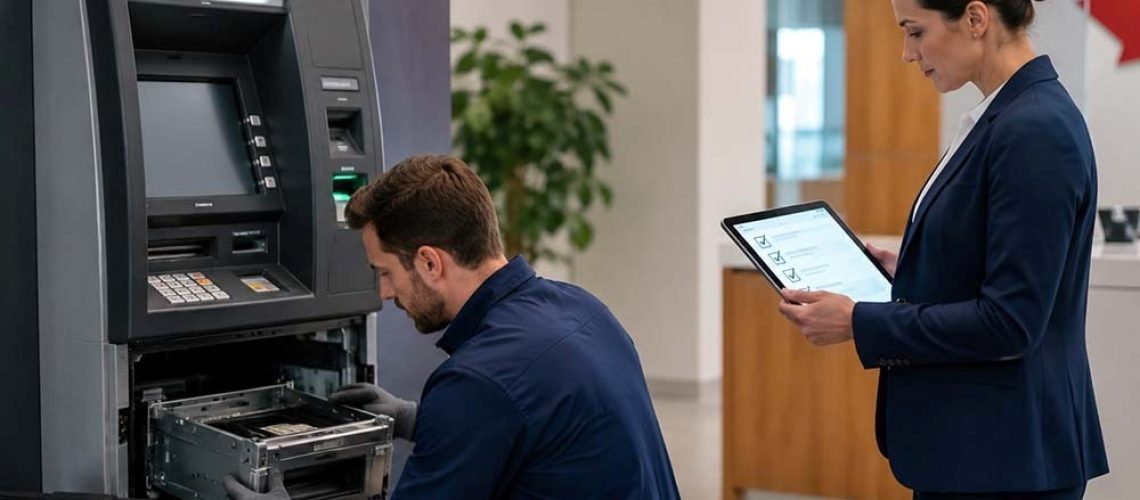

Owning an ATM can create a revenue stream. However, the purchase price is the beginning. Understanding the total cost of owning an ATM in Canada in 2026 means budgeting for hardware, installation, processing, connectivity, cash replenishment, insurance, maintenance, and repairs.
Canadian suppliers advertise standard commercial machines in the roughly $2,500 to $6,500 range, depending on whether the unit is used or new, its cash capacity, security features, and configuration. ATM ownership expenses in Canada 2026 continue long after installation.
ATM Purchase and Installation Costs
A basic indoor ATM is usually less expensive than a through-the-wall or high-security model. In addition to the machine, owners may pay for delivery, installation, bolting, signage, electrical work, internet setup, cellular hardware, or site modifications.
When calculating the total cost of owning an ATM in Canada 2026, ask suppliers exactly what is included in the quoted price.
One of the hidden costs ATM machine Canada operators sometimes overlook is the cash required inside the ATM. That cash creates a working-capital requirement and must be replenished as customers withdraw funds.
Processing and Connectivity Fees
Every independent ATM requires transaction processing and network connectivity. Current Canadian provider pricing can include monthly processing charges, per-transaction fees, and optional cellular or modem fees. One Canadian provider lists monthly processing around $10 to $30 per ATM, transaction fees around $0.05 to $0.15, and wireless connectivity around $10 to $15 monthly.
These charges should be included when estimating ATM running costs in Canada.
Processing is one of the most important ATM ownership expenses in Canada 2026 because even small per-transaction charges increase as volume grows. Owners should compare processing costs alongside settlement schedules, technical support, monitoring tools, contract length, and surcharge revenue terms.
Maintenance, Repairs and Supplies
ATMs contain card readers, printers, cash dispensers, screens, keypads, communication equipment, and security components. Regular operation creates wear, and unexpected failures can require service calls or replacement parts.
Receipt paper is inexpensive individually, but supplies, technician visits, software updates, replacement components, cleaning, and downtime contribute to ATM running costs in Canada. Owners operating several machines should create a maintenance reserve rather than assuming every month will be repair-free.
Another hidden cost of ATMs in Canada to consider is downtime. When a machine is empty, offline, or malfunctioning, it cannot generate surcharge revenue. Fast technical support and remote monitoring help protect uptime and profitability.
Cash Loading and Security
Someone must replenish the ATM with cash. The right choice depends on transaction volume, location, risk, and operational capacity.
Cash transportation, employee time, reconciliation, secure storage, and refill trips can influence the total cost of owning an ATM in Canada 2026. These costs matter especially for machines located away from the owner’s main business.
Insurance is another consideration. General business insurance is not universally required simply because a company owns equipment, but commercial property, equipment, crime, or other coverage may help protect against specific risks depending on the operation and policy terms. Discuss ATM ownership with a licensed insurance broker instead of assuming an existing policy automatically covers the machine or its cash.
Calculating ATM Payback
Profitability depends largely on monthly withdrawal volume, customer surcharge, processor fees, location agreements, cash-loading costs, maintenance, and downtime. When reviewing ATM ownership expenses in Canada 2026, calculate net income rather than simply multiplying transactions by the customer surcharge.
A strong location may recover its investment faster than a low-volume location. Hidden costs ATM machine Canada owners should include in payback calculations include connectivity, repairs, insurance, cash management, location revenue sharing, and the opportunity cost of cash sitting inside the machine.
Understanding ATM running costs in Canada before purchasing provides a more realistic picture of potential return.
FAQ’s
Q1. What are all the ongoing costs of running an ATM machine in Canada?
A: Ongoing costs may include processing, connectivity, receipt paper, maintenance, repairs, monitoring, cash loading, insurance, security, and location revenue sharing. Costs vary according to the machine, processor, service arrangement, and transaction volume.
Q2. How much does ATM transaction processing cost in Canada?
A: Pricing varies by processor. Some Canadian providers advertise monthly processing fees plus small per-transaction charges, while others use customized pricing or surcharge-sharing arrangements. Always request a complete fee schedule before signing.
Q3. Do I need insurance for my ATM in Canada?
A: There is no single insurance answer for every operator. Coverage needs depend on ownership structure, location, cash exposure, existing business policies, and contractual requirements. Ask a licensed Canadian insurance broker whether equipment, property, crime, or liability coverage is appropriate.
Q4. How long before an ATM pays for itself in Canada?
A: There is no guaranteed payback period. It depends on purchase cost, transaction volume, surcharge revenue, operating expenses, and location quality. Calculate monthly net profit after all expenses, then divide your initial investment by that figure to estimate a realistic payback period.